Saturday, November 22, 2014

Planned Parenthood


Cecile Richards Says Aborting My Baby “Wasn’t a Difficult Decision”

by Steven Ertelt 

The head of the nation’s biggest abortion business recently doubled down on her claim that aborting her own child “wasn’t a difficult decision.”
cecilerichards29Earlier this year, LifeNews broke the story that Planned Parenthood CEO Cecile Richards thinks apparently it was no big deal to take the life of her unborn child. Planned Parenthood does over 330,000 abortions on an annual basis and Richards opened up about her own abortion in an essay published in Elle, writing that she thinks of more women share their abortion decisions it will stop the “stigma” surrounding abortion.

“I had an abortion. It was the right decision for me and my husband, and it wasn’t a difficult decision,” Richards wrote at the time. “Before becoming president of Planned Parenthood eight years ago, I hadn’t really talked about it beyond family and close friends. But I’m here to say, when politicians argue and shout about abortion, they’re talking about me — and millions of other women around the country.”

Now, the abortion business executive has uploaded a new video explaining her abortion decision.
In the new video, uploaded November 20, Richards states almost the same thing she wrote in her article: “I had an abortion. It was the right decision for me and my husband and it wasn’t a difficult decision. But before I joined Planned Parenthood, I didn’t really talk about it except with family and close friends. But today, I’m telling my story…No woman should ever be forced to justify her reasons to have an abortion….”

Richards doesn’t provide the details surrounding her abortion — how old the baby was at the time of the abortion or why she ended her baby’s life rather than carrying the pregnancy to term or considering adoption.

But if Richards thinks abortion stories will change the abortion debate, she is forgetting the millions of women who have had abortions and profoundly regret their decision. She is forgetting women like Kathy:
The truth is when I was 19 years old I got pregnant. Upon telling my parents; they decided that I would get married. We began to plan a very quick wedding. The boy I was dating at the time turned out to be abusive. He was from an abusive home and had his father had brutally beaten his first wife in front of her two sons. The first time this boy threw me to the ground while I was pregnant I knew there was NO WAY I was going to allow this cycle to repeat. I broke off the engagement and began looking into adoption. I was only 19 and I knew I wasn’t ready to be a mom. When I told him I wanted to make an adoption plan, that I knew that was the best choice for us and the baby, he became very angry. Threatening, yelling, and screaming, he told me no one would EVER take the mother of his child or his child away from him. He wouldn’t allow it – that we WOULD be together. I became scared. Fear set in like I can’t even begin to explain. I realized that I could be a victim of abuse or I could save myself and my unborn child and choose to make this all disappear. I told him I had a miscarriage (which is what I told everyone else too).
Walking into Planned Parenthood the smell of depression and hopelessness lay thick in the room. Yes, I could actually smell it. None of the women looked thankful that they had the “choice” to be there. They all looked empty. Broken. I felt it too. I had always said I would NEVER have an abortion. I was wrong. In my mind I believed it was the only “choice” I had at the time to protect myself and my unborn child from a life of fear and abuse. My name was called and I headed in the back. I was scared and alone.
I hear people talking about the right to “choose.” I wish like HELL I didn’t have the right to choose that day.I wish there had been counseling. I wish there had been adoption agencies out there trying to reach the youth. I wish THOSE things were easy access; NOT Planned Parenthood. I wish more than anything, ANYTHING, I could have taken away MY right to choose and allow my baby to have their right to choose life. I wish there was support out there for girls like me. And maybe there was…but Planned Parenthood was easy to find. Abortion is easy. Walk in, walk out. Done. Pregnant. Not Pregnant. Simple. Except…it’s NOT that simple. They forget to tell you about the rest of the story.

The truth is they don’t tell you about the memory you live with for the rest of your life. For awhile I was able to forget. I had to suppress the memory in order to survive MY right to live. But slowly the memory began to resurface. Back to the room…back to the smells…back to the empty eyes of broken women. Back to the face of the man that literally sucked life out of my body.
Abortion is not about choice. It’s about selfishness. It’s about desperation. And I can say that because I have had one. I have walked a mile in those shoes…and it’s a mile that never ends.
Recently a friend asked me if I had ever named my baby. Immediately I thought, “No, because that would make it real!” Then the “fetus” would become human. Become a baby. But I knew in that moment I needed to acknowledge that my baby is real. I needed to mourn the loss of my child. I realized how deep the pain still ran from my right to “choose.” I began to pray that God would give me a name. A few weeks ago while driving in the car I heard God speak to me: “Her name is Joy.” Tears streamed down my face. It was a girl! I had had a daughter.

Source: LifeSite News

Friday, November 21, 2014

Side Effects

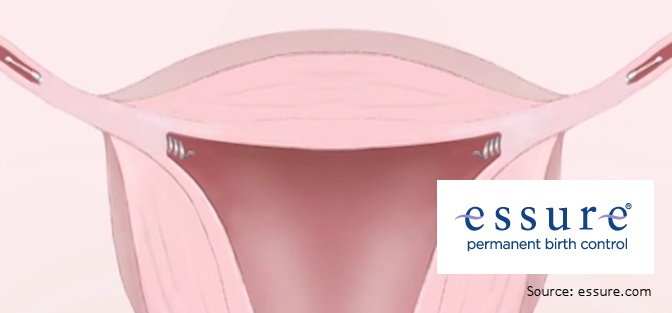
essure

Essure birth control is ruining women’s lives

According to recent news coverage and personal testimonies, hundreds of women have experienced adverse side effects from Essure – “the only non-surgical, permanent birth control available”.
How does it work? Metal coils are inserted in both fallopian tubes, causing a woman’s body to grow tissue through them, blocking the fallopian tubes. In most cases, this prevents pregnancy by making eggs unable to reach the uterus.
But Essure stories aren’t all happily finished families as the product owner, Bayer, would like you to think.

According to the safety warnings on their website, Essure doesn’t sounds terribly problematic. The adverse effects are, as they say, so rare that it’s unlikely to happen to an average person. Right?
But the women who have gone through horrible situations would tell you not to gamble with the risk. These stories include:
Many women have experienced unexplained health issues they attribute to Essure, and to top it off, a hysterectomy is usually their only given solution. They now have a support group of nearly 12,000 women in a private Facebook group and are trying to have Essure taken off the market.
Essure was approved by the FDA in 2002 when it was owned by Conceptus, and it is now owned by Bayer. But a problem women are facing is that they cannot sue for the thousands of dollars of medical expenses they have because of these tiny coils. Why? Because back years ago before it all began, Essure was given a FDA preemption.

Robert Jenner, an attorney with Janet, Jenner and Suggs in Pikesville said that “the idea behind preemption is that the companies that make approved devices get protection from the FDA and can’t be sued because the agency so heavily scrutinizes their devices.”
However, legal professionals disagree with this preemption because he continued, saying there’s “simply not enough money, not enough time and not enough people in the FDA to give it the oversight, the attention that it needs”.
Essure is still on the market, and women continue to share their stories after experiencing problems with this dangerous product. Find out how to report problems here.
To discover more natural alternatives to managing reproductive health which respect the dignity of all systems of the human body, visit here and here.
We deserve healthcare that won’t hurt us. Families deserve better than having unexpected medical problems they could have avoided. And ultimately, women deserve better than tiny metal coils that ruin their lives.

Source: LiveAction News

Trip to PP


University funded organization takes field trip to Planned Parenthood

Blake Seitz, a student of the University of Georgia and editor-at-large of The Arch Conservative broke the news of  a university funded group on his campus, SHAG (Sexual Health Advocacy Group), taking a field trip to Planned Parenthood, a sex shop, and a cross-dressing organization.
While neither SHAG nor the group’s faculty adviser responded to repeated requests for comments about the excursion, the vice president for public affairs at the university responded by e-mail:
Thomas Jackson Jr., vice president for public affairs at UGA, told The College Fix the trip held academic value.
“As future health educators and counselors, they study and learn about a wide range of matters so as to gain accurate information and learn best practices in providing health education and counseling to the public,” Jackson said by email. “The visit to Planned Parenthood and an adult store was chosen by the students so that they might get an understanding of the types of issues with which they’ll be working as future health educators and counselors.”
Regardless as to if such a visit “was chosen by the students…” it does not merit any claims of having “academic value.” That is unless “academic value” now can refer to spending three hours hearing from an organization which promotes and performs abortions.

And as Seitz’s piece points out about the sex shop, Intersection:
Inserection is an adult sex shop that sells a wide variety of items, including vibrators, edible underwear, pornography, pipes and water bongs, and lingerie. At night, the downstairs portion of Inserection becomes a sex club complete with “gloryholes,” according to multiple YELP reviewers, with one noting “this is not for the faint at heart … This place is JUMPING on the weekend for all you freaks out there.”
Thomas Jackson Jr.’s lauding of the school trip, “so that [the students] might get an understanding of the types of issues with which they’ll be working as future health educators and counselors[,]” is even more woefully misguided then. How can students hope to get the proper kind of understanding when interacting with an organization which has such bias towards issues of sexual health, when killing one’s own child can be regarded as health care?
With such an interaction with Planned Parenthood, it sadly would not be shocking that SHAG would participate in protesting pro-life displays on campus, as Seitz mentions in his piece. Yet oddly enough, SHAG claims on their homepage to be “an all inclusive, non-judgmental group…”
Reporting on the field trip, Breitbart’s Dr. Susan Berry commented that:
Fall SHAG events included a Community Health Day which provided “free HIV testing” as well as a “free plate of BBQ,” a “Cupcakes and Condoms” event, and “Pillow Talk: Sexy Little Things,” which was “devoted to talking about not-so-typical forms of sex and sexual acts.”
SHAG celebrated Halloween with a “Halloweiner Party,” and plans to kick off the Christmas season with a “Secret Sexy Santa” event that will feature a “sexy gift exchange from SHAG members.”
It’s bad enough that a group like SHAG is treating the gift of human sexuality in a way many would find to be distorted. And all this is being done by a funded student group. But now a group which claims to be “all inclusive” ventures off to Planned Parenthood, which is certainly not all inclusive. That truly is a shame

Source: LiveAction News

China


The Story of The Drop Box


By Natalie Brumfield
drop-box-20091Lee Jong-rak is a Korean pastor in South Korea. A simple man with a huge purpose, Pastor Lee saw a devastating problem. He thought of a way he could change it, and he became a prophetic voice to his society. His story is a story of faith. A story of hope. A story of love. And when you hear this heroic tale, you just may never be the same.
Lee Jong-rak is the creator of the Baby Box. His Baby Box is the first and only box in Korea that is for collecting abandoned babies who are physically or mentally handicapped, or are just unwanted by their mothers.

Hundreds of unwanted babies are abandoned on the side of the street in South Korea every year. Jong-rak knew he needed to set up a way to save the lives of these precious babies. He built a drop box on the side of his home with a humble sign reading, “Place to leave babies.”
pastor-baby2The inside of the box contains a thick towel covering the bottom, and lights and heating to keep the baby comfortable. A bell rings when someone puts a baby in the box; then Pastor Lee, his wife, or staff associates come to immediately move the baby inside.
His aim was to provide a life-giving alternative for desperate mothers in his city of Seoul. He even admits that he didn’t really expect that babies would come in; he was mistaken. The babies came. In the middle of the night, in the middle of the day, some with notes, some without a word, and only a very few mothers actually spoke to him face-to-face.

Pastor Lee stated that one of the mothers said, “I have poison to kill both myself and my baby.” He responded, “Don’t do that. Come here with your baby.” One single mother left this heart-wrenching note with her baby. The English translation follows.

“My baby! Mom is so sorry.
I am so sorry to make this decision.
My son! I hope you to meet great parents, and I am very, very sorry .
I don’t deserve to say a word.
Sorry, sorry, and I love you my son.
Mom loves you more than anything else.
I leave you here because I don’t know who your father is.
I used to think about something bad, but I guess this box is safer for you.
That’s why I decided to leave you here.
My son, Please forgive me.”
Baby-girl-dropped-off-in-baby-box3My breath was taken away as I read, “I used to think about something bad, but I guess this box is safer for you.” Yes, this little box is a safer place than the plans that once haunted this single mother’s mind. Because this box was an alternative, she chose life. Thus, this box would be the beginning of a previously undreamed ministry in Korea, the ministry of the Baby Box.
The story of this man and his baby box is reaching the entire world with its own 72-minute documentary called “The Drop Box” by a young 22 year-old, Brian Ivie. The documentary won the “Best of Festival” Jubilee Award and “The Best Sanctity of Life” film award at the 8th annual San Antonio Independent Christian Film Festival in February 2013.

Ivie was stirred to do the film after reading an article in the Los Angeles Times about Pastor Lee’s mission, and he decided to go to Korea to make the documentary. After seeing the testimonies of this orphanage up-close, Brian Ivie’s life was changed. In his acceptance speech, Ivie said, “These kids are not mistakes. They are important.”
5-babies-abandoned-in-the-box-in-one-day-this-April4He went on saying, “I became a Christian while making this movie. When I started to make it and I saw all these kids come through the drop box – it was like a flash from heaven. Just like these kids with disabilities had crooked bodies, I have a crooked soul. And God loves me still. When it comes to this sanctity of life issue, we must realize that that faith in God is the only refuge for people who are deemed unnecessary. This world is so much about self-reliance, self-worth, and self-esteem. It’s a total illusion that we can be self-sufficient. Christ is the only thing that enables us.”

The documentary that changed Brian Ivie’s life is bound to change the lives of the film’s audience. Following their success with Irreplaceable, Focus on the Family is working with the film producers and Fathom Events to screen “The Drop Box” in theaters nationwide on March 3-5, 2015. Be sure to like the movie’s Facebook page and connect directly with Pastor Lee’s ministry at Kindred Image.
I scrolled through the stories on Facebook, I was overwhelmed to see a post dated as April 17th where one of the staff members of the Baby Box orphanage stated that they had received five babies in one week and to pray for them. There beside her request was a picture of five beautifully bundled babies. In my head, all I could think was, “This is the real thing. This ministry is the real thing.”
Korea is not the only place that deals with child abandonment. Globally, millions of children die from abandonment. It takes different forms from country to country.
PastorLee6405In the United States, abortion serves our abandonment purposes and they call it a “woman’s choice.” Our nation is still struggling to see that these babies are human beings, too. They deserve to live just like any other human being. With incredible men and women like Pastor Lee, this world is seeing how life can be for these babies when we take them in; when we become a voice for the ones that cannot speak up for themselves.

They are loved, they are cherished, and they are worthy just the way they are.
“They’re not the unnecessary ones in the world. God sent them to the earth to use them.” – Pastor Lee Jong-rak in The Drop Box documentary

Editor’s note. This appeared at bound4life.com. Natalie Brumfield has been the Bound4LIFE Birmingham Chapter Leader since 2008. She works as a children’s director and curriculum writer for the children’s ministry at her local church in Birmingham, Alabama. She’s on the leadership team for the Birmingham Prayer Furnace as a prayer leader and serves as a weekly counselor for Sav-A-Life, a local pregnancy test center.

Source: NRLC News

Media Bias


Terse 5-Paragraph AP Story Shows It Clearly Wants the Gruber Story to Go Away


By Tom Blumer
As I noted Monday, the Associated Press, aka the Administration’s Press, finally broke down on Friday and mentioned the name “Jonathan Gruber” in a news story — a Friday afternoon item which, among other things, dishonestly attempted to distance the Affordable Care Act advisor from his long acknowledged and celebrated (until recently) “architect” role.
As of early evening, the only other AP mention of Gruber has come in an unbylined Sunday morning story on President Barack Obama’s insistence that, in AP’s words, “the American public was not misled about certain provisions of his health care law,” and that, again in AP’s words, “there was no provision of the health care law that was not extensively debated and was not fully transparent.” The terse, “Now will you people please go away?” five-paragraph report follows the jump:

APonObamaGruber111614at2am
Note the reference only to a single “newly surfaced video,” even though there have been, at last count, ten damning videos which have gained visibility in the past week — all of them betraying Jonathan Gruber’s contempt for the American people and virtually anyone else challenging him or “his” law.

The AP writer also repeated the assertion, shown to be false in yesterday’s post, that Gruber has “disavowed” his remarks. He has done no such thing. As I wrote yesterday in response to reporter Philip Elliott’s attempt to slide such garbage past us:
Gruber has never unconditionally said “I’m sorry.” Gruber has never said that any of his statements were wrong. Thus, he has NOT “disavowed” his remarks. He has only said that he shouldn’t have said them.

The original question and the text of Obama’s response as carried at the White House web site is as follows:
ED HENRY: At your Burma town hall a couple days ago you tried to inspire young leaders by saying governments need to be held accountable and be responsive to the people. I wonder how you square that with your former advisor, Jonathan Gruber, claiming you were not transparent about the health law? Because in his words, the American people, the voters are stupid. Did you mislead Americans about the taxes, about keeping your plan, in order to get the bill passed?
PRESIDENT OBAMA: No, I did not. I just heard about this. I get well briefed before I come out here. The fact that some advisor who never worked on our staff expressed an opinion that I completely disagree with in terms of the voters, is no reflection on the actual process that was run.

We had a year-long debate, Ed. I mean, go back and look at your stories. The one thing we can’t say is that we did not have a lengthy debate about health care in the United States of America, or that it was not adequately covered. I mean, I would just advise all of — every press outlet here: Go back and pull up every clip, every story, and I think it’s fair to say that there was not a provision in the health care law that was not extensively debated and was fully transparent.
Obama’s response is simultaneously laugh-out-loud funny and sad. This is the same guy who said dozens of times that “If you like your plan, doctor, provider, and drug regimen, you can keep them — Period.” We all know now that this core guarantee — not just a promise, a guarantee — was a lie, and that there was virtually no entertaining of the idea that Obama’s assertion might not be true in the establishment press in the runup to the law’s passage.

The best response to Obama’s “extensively debated” claim comes from then-House Majority Leader Nancy Pelosi. In 2010, she acknowledged that the details of the law were a complete mystery to virtually everyone just days before it passed, when she told a friendly audience that “we have to pass the bill so that you can find out what is in it”:
At the 2010 Legislative Conference for the National Association of Counties in regard to the Healthcare Reform Bill AKA Obamacare, House Speaker Nancy Pelosi said, “But we have to pass the bill so that you can find out what is in it, away from the fog of controversy.”
Pelosi knew — as did Jonathan Gruber — that only a lack of transparency would enable the law to pass.

But the AP’s unidentified writer doesn’t care. He or she, and the wire service employing him or her, desperately want dissenters to listen to Dear Leader, shut up, and move on.
Editor’s note. This appeared at newsbusters.org.

Source: NRLC News

United Nations


U.N. marks 25th anniversary of Convention on the Rights of the Child


New brochure highlights areas in which many children remain unprotected
RightsofChild_2014reNEW YORK, N.Y. — On Nov. 20, 1989, the United Nations General Assembly affirmed the dignity and rights of all children by adopting the Convention on the Rights of the Child. Events marking the 25th anniversary of the recognition of those rights will be held Thursday at the United Nations in New York.

As nations celebrate their accomplishments in establishing legal rights and protections for the world’s children, the unmet needs of multiple millions of young human beings must be prioritized in order to secure their safe and hopeful future. A new literature piece, “Celebrating the Rights of the Child,” details areas in which the rights of children still are not honored or defended.
“On the 25th anniversary of this landmark human rights treaty, we should celebrate our progress on behalf of the youngest members of the human family while also acknowledging the ways in which the rights of children remain unprotected,” said Scott Fischbach, Executive Director of Minnesota Citizens Concerned for Life Global Outreach (MCCL GO), a U.N.-accredited non-governmental organization. Fischbach will be in New York for Thursday’s U.N. events.

The first 1,000 days of a child’s life—from conception to the second birthday—dramatically shape his or her prospects for survival and future well-being. Lives can be saved by improving the quality of care during labor, childbirth and the days following birth, including essential newborn care. Prenatal care and nutrition and optimum breastfeeding are also important to ensure healthy development.

Tens of millions of abortions occur around the world each year, and countries that protect unborn children face pressure to legalize the procedure. This is a profound injustice. The Convention on the Rights of the Child affirms that, quoting the Declaration of the Rights of the Child, “the child, by reason of his physical and mental immaturity, needs special safeguards and care, including appropriate legal protection, before as well as after birth” (preamble). All children, born and unborn, deserve protection.

The Convention calls for securing the rights of each child “without discrimination of any kind” (Article 2). But sex-selective feticide—when abortion is performed solely on the basis of the unborn child’s sex—is a massive problem in areas where culture and tradition favor boys over girls, including parts of Asia, Southeast Europe and the Caucasus.
“Great progress has been made in the past 25 years on behalf of children,” said Fischbach. “But many still suffer. All children, born and unborn, male and female, have an equal dignity and right to life. They deserve our respect, protection and care.”
MCCL GO is a pro-life NGO global outreach program of the Minnesota Citizens Concerned for Life Education Fund.

Source: NRLC News

Adoption


I. Love. Adoption.


By Joleigh Little
Editor’s note. November is National Adoption Month. We’ve been running new and previously run stories on adoption all month. This wonderful post appeared yesterday on the author’s wordpress account, “See Joleigh Adopt.”

Adoption is hard. Adoption is messy. Adoption takes work. Adoption is expensive. Adoption will bring you pain. Adoption will take the life you once knew, turn it upside down, chew it up and spit it out in pieces that are barely recognizable.
Now… please go back and substitute “parenting” everywhere I wrote “adoption.”
Huh. Still accurate, isn’t it?

But that’s just one side of the coin. Adoption is also rewarding. Adoption brings joy. Adoption gives children families. Adoption will take the life you once knew, shave off a whole lot of the selfish, destroy a giant dose of the pride and bring you repeatedly to your knees, which is where you should have been in the first place. (Again, an awful lot like parenting!)

I have heard time and again that every adoption begins with brokenness. This is true. We live in a broken world. There are broken things. There are broken people. Evil exists. Terrible things happen. If you carry it back far enough, and I’m talking Garden of Eden far, our existence as a race began with brokenness. Disobedience. Arrogance. And ever since that time, the voice of the serpent is still hissing in the affairs of man. If you doubt this, turn on the evening news.
But. And there’s always that “but” isn’t there?

It’s totally up to us to decide what to do with that brokenness. Wallow in it? Rage against it? Stomp our feet and talk about how unfair it is? Give up and shut ourselves away from it?
Or… fix it. Where we can, how we can, with what we have.

Adoption is the result of brokenness, yes. But it is NOT the cause. It is, in fact, the solution. That solution doesn’t come easily. As an adoptive family you are absorbing into your midst someone who has been hurt. Sometimes brutally. Sometimes in ways that are subtle.
It’s okay, though, because you have been hurt, too. Everyone has. And because of that hurt, because you have lived for so long in a broken world, you have a gift that you can give to other broken people. It’s called empathy. You might also call it compassion. In short, it is love. The greatest gift we can give another human being.

And that’s why I love adoption.

I love adoption because adoption is the solution to often terrible problems. Adoption takes a child who has been abandoned, or hurt, or broken and makes that child a son or a daughter.
I love adoption because it gives those of us who are mere mortals a very real sense of how God feels about us.

I love adoption because it takes children from situations in which no child should EVER live and brings them to a place of safety. It pulls children out of an existence that is often very difficult and places them in a life that, while perhaps still difficult, will at least allow them to heal.
Closer to home, and by that I mean domestically, I love adoption because I have friends who, for whatever reason, cannot create biological children. Adoption has made them parents. Really great parents, in fact.

I love adoption because it gives scared women and girls, who are unprepared to parent, a very real and viable alternative to ending the lives of the tiny people growing inside of them.
I love adoption because it is the absolute best solution in a situation where parents cannot raise their biological offspring to adulthood.

That doesn’t mean I love the poverty, the drug or alcohol abuse, the death or the other horrible circumstances that make adoption necessary. But I sure as holy horse radish love the solution! I love that there IS a solution and I love that it’s a good solution.
I agree that the hard side of adoption needs to be discussed. It’s not all purple unicorns, shiny hearts and fuzzy kittens. But, then, neither is life. People are hard to love sometimes. YOU are hard to love sometimes. I know I am.

I will even go so far as to say that I love adoption because it is hard. I think that sometimes we have things a little too easy here in our comfortable American lives. We eat our fast food, drive our fast cars, scurry through our days from one thing to the next, giving our kids 16 different extracurricular activities and, let’s admit it, as often as is humanly possible, we choose to do things the easy way.
But “easy” doesn’t always equal “right.” For me, “easy” would have been to continue living my life, throwing myself into a job I love, passing my evenings and weekends knitting and spending my extra cash on beautiful, expensive yarn and not ever stepping out to make a stranger my own.
I can’t even write that without crying because while my now sometimes upside down life is very different from my carefully ordered world of four years ago, and most definitely a lot harder, it is so much better. Richer. Fuller. Happier. Funnier. Whole.
And this is the reason.

Her story begins with brokenness. Abandonment. Having to fight for limited attention from too few caregivers for too many children.

Our story together is not without its rough spots. She’s very strong-willed. (So am I.) She’s a little bossy and controlling. (So am I.) She has excellent verbal skills and needs to learn to use them for good and not for evil. (So do I.) In the beginning, I had to choose to love her. Actively choose. Because she wasn’t familiar those first few weeks and months, and she really did very suddenly change my nirvana into a nightmare on a few levels. (Think split lips, a loose tooth and constant bruises across my thighs while she fought her way into my heart.)
But, somewhere along the way, after choosing to love her, something beautiful happened.
She became mine.

So, I love adoption for all of the reasons I outlined above, and more. But the biggest reason I love adoption is that Clara has a mom. And I love that God chose me to be that mom.
So yes, adoption is hard. But it is also so amazingly and achingly beautiful. As a wise friend of mine, who has also chosen to love a child she didn’t make, recently said, “God calls us to do hard things. God equips us to do hard things.”

In closing? Please. Go do hard things. And remember that “hate” is a very strong word — especially for something that brings such incredible beauty out of brokenness.

Source: NRLC News

Life is Beautiful


Mom refuses to take “no” for an answer, baby said to have less than 5% chance of surviving is now thriving


By Dave Andrusko
Graceanne with her older sister Allie Claire

When Graceanne Payne came home from the hospital, just before Christmas 2013, she joined her mom and dad and older sister one day before her actual due date. Almost a year later, she “crawls enthusiastically and has already taken her first steps,” according to Scott Rogers of the Gainesville Times.

So, Graceanne came a little early? Actually she arrived September 8, 2013, weighing 1 pound, 12 ounces. She was so premature doctors had given her less than a 5% to survive. Graceanne experienced a 97-day stay in the Neonatal Intensive Care Unit at Northeast Georgia Medical Center and spent almost six weeks on a ventilator.
“Definitely the hand of God was involved in her survival,” her mom, Melissa Payne, said.
Graceanne’s remarkable story began when the Payne family was visiting relatives in Maine. Rogers explained

Only in her second trimester and more than 1,300 miles away from home, Payne woke to discover her water had broken. She was taken to the nearest emergency room, where doctors said her unborn daughter Graceanne would need to be delivered in the next 24 to 72 hours.
“At that point, we weren’t quite 19 weeks, so she wouldn’t have been able to survive,” Payne said.
They visited a specialist in a nearby town who “pretty much told me this was the hand of cards we were dealt, and we would have to fold them and start over,” Payne told Rogers. Meaning the prediction of a less than 5% for survival and the likelihood that, if she did survive, “he would have a very low quality of life and be a burden on their family.”
But Payne had no interest in giving up on their baby and was determined to return to their home in Georgia.

Rogers explained that several of her friends “orchestrated her return to Georgia and set up her appointment with the obstetrician-gynocologist who approved her for continuing the pregnancy.” And
When Payne’s doctor performed an ultrasound and found a heartbeat, she was given the cautious — though not optimistic — OK to do what her heart told her to do. Payne wanted to continue her pregnancy, come what may.

“I believe that all babies are conceived for a reason,” Melissa Payne said. “It is our job to try to protect them and support what they need. Even when it’s difficult or very trying, what some could see as a burden to your family is still a gift from God.”
Payne was, of course, put on immediate bed rest. She told Rogers of feeling Graceanne kicking and moving and then going to the doctor “and they’d just frown and nod.” To keep strong for her baby, she Payne said she “relied on her family, friends, prayer and visits from church deacons to get her through the next seven weeks.”

Graceanne was born via an emergency C-section at 26 weeks and 2 days, weighing 1 pound, 12 ounces and measured 12 inches long. She had many health hazards—starting with having sufficient lung capacity to breathe on her own or be put on a ventilator.
“I woke up in recovery and asked where the baby was,” Payne said. “They said she was down in the NICU, and had enough lung tissue to ventilate.”

Of course, there were more hurdles to overcome, but as Graceanne’s health improved, so did her doctors’ optimism. Graceanne went home just in time for Christmas, 2013. Far from having medical issues, she is right on schedule, developmentally.
Carolanne Owenby, who was instrumental is helping Melissa find the right kind of help back in Georgia, calls Graceanne “the greatest miracle I’ve known in my life.” But according to Rogers, she credits another source for her survival.

“(Graceanne) was told over and over again that she had no business being here, that she wouldn’t be here, and she’s not only here but she’s thriving,” Owenby said. “A huge part of that is a testament to her mother. Melissa is one of the strongest people I know. She fought tirelessly for (Graceanne) and refused to take no for an answer at every corner. And that’s why she’s here and that’s why she’s thriving.”

Source: NRLC News

Thursday, November 20, 2014

Eldery


“Alive Inside” and the power of music to arouse the elderly


A touching documentary asks why so many elderly have been abandoned in dehumanising nursing homes.
By Michael Cook
aliveinside43Caring for patients with dementia will probably be one of the biggest human dignity issues of our century, as the proportion of elderly grows across the globe.
So I was really delighted to see a ray of light in a new documentary, Alive Inside, which won the 2014 Sundance Film Festival Audience Award for an American documentary [www.aliveinside.us]. It features the power of music to raise patients out of their torpor. Sometimes the effect of placing earphone and an iPod on an unresponsive patient slumped in a wheelchair is little short of miraculous.

This solution is being promoted with missionary zeal by Dan Cohen, a technology consultant who has founded a group called Music & Memory.
One wonderful clip from the film features Henry, who spends his days in an almost catatonic state in a 600-bed nursing home. But when Dan places the earphones on his head and he hears the music from a favourite artist of his youth, Cab Calloway (famous for “Minnie the Moocher”), he begins to answer questions, his eyes light up and he even gives a short speech:
“It gives the feeling of love, romance! I figure right now the world needs to come into music, singing. You’ve go beautiful music here. Beautiful. Lovely. I feel band of love, of dreams. The Lord came to me, made me holy. I’m a holy man. So he gave me these sounds.”
There are many such moments in the film. The joy on the face of patients will bring tears to your eyes.

The film also critiques over-reliance on anti-psychotic medications for demented patients. “What we’re spending on drugs that mostly don’t work dwarfs what it would take to deliver personal music to every nursing home resident in America,” says Dr Bill Thomas, a charismatic gerontologist. (What does it say about our view of the elderly that this sounds like an oxymoron?)
“I can sit down and write a prescription for a US$1,000 a month antidepressant, no problem. Personal music doesn’t count as a medical intervention. The real business, trust me, is in the pill bottle.”
Obviously iPods and Cab Calloway playlists alone will not turn dementia around; individually and collectively the issue is far more complex than this. But this uplifting documentary at least shows that some simple solutions work.

You cannot watch “Alive Inside” without asking questions about the future of old age in our society. Why do we have massive nursing homes, where half the residents may get no visitors, where most live lives of boredom, helplessness and loneliness. Henry was lucky; his daughter visited him fairly often. Others are completely alone in the world. How can these institutions be transformed into places where the residents are seen as human beings first and patients second?

Perhaps, as Dr Bill Thomas suggests, there is something fundamentally wrong with the way that America (and similar societies like Canada and Australia) view the elderly. The pinnacle of our lives is adulthood, the time when we are independent, self-sufficient and, above all, productive. Adults are supposed to work like machines. And just as superannuated machines are scrapped, the elderly end up hidden in nursing homes. Thomas argues that we need to recover the notion of what he calls “elderhood,” the stage of life where people continue to produce, even though what are producing is wisdom and love rather than widgets.

Are developed societies ready for the epidemic of dementia? Already there are 35 million people over 65 in the US and that number will double by 2030. Are these dehumanising nursing homes the answer?

“Alive Inside” asks more questions than it can answer. In the end it is about how music supports our humanity. Director Michael Rossato-Bennett says that his life was transformed by making it. “I hope it will bring the story of Dan’s work to the world and awaken hearts and minds to the healing power of music. Music has great lessons to teach us about what it means to be human. I learned that from the sweet and vulnerable souls I met making this film.

“Through music, we have the power to help millions of people awaken to who they are and what they can be,” he adds. “Music gives us the ability to reach a population that might otherwise be unreachable. It allows us to touch hearts and ignite souls. Through music, we can help the old and the aging sustain their humanity and by doing so, inevitably, we’ll prove our own.”
Michael Cook is editor of MercatorNet. This appeared at mercatornet.com

Source: NRLC News

Life a Beautiful Choice


Nearly-aborted, Ghanaian teenager wins Junior Olympic gold medal


By Dave Andrusko
Editor’s note. This inspiring story appeared in the November post-election issue of National Right to Life News. You can read the entire 34-page edition at www.nrlc.org/uploads/NRLNews/NRLNewsNov2014.pdf
17-year-old Martha Bissah just after she won a gold medal in the Junior Olympics. With her are the Silver and Bronze medal winners.

I follow sports very closely, youth sports almost as closely, but I confess I missed that the first-ever Olympic gold medal won at any level by a Ghanaian was by 17-year-old Martha Bissah.
Competing last August in the Youth Olympics in Nanjing, China, Bissah ran a 2:04.90 in the 800 meter final, a new junior Olympic record.

According to a Ghanaian newspaper

An enchanted TV Commentator at the Youth Olympics commented about Martha’s achievement saying, “Martha Bissah the Ghanaian has given us a glimpse of a glorious future…without any shadow of the doubt… that was world class….if someone can tidy up that technique, she will be a force to be reckoned with when she becomes a senior.”
But there is (to quote the immortal Paul Harvey), a “rest of the story”—that she almost didn’t have a future. The details come courtesy of a story written for Ghanaweb.com by Ebenezer Afanyi Dadzie.
The headline gives us the startling truth—“Martha Bissah: A nearly aborted foetus now a world champion.”

Remember that this story is being told from the perspective of the writer who describes his nation as a “third world country” where the chance to go abroad, and possibly take up residence there, is a powerful inducement for anyone.
In this instance, Bissah’s teenage mother was an athlete and a good soccer player in her own right. She had a chance to go abroad (the story is a little vague here) when she checked into the hospital feeling poorly. She was pregnant!

Dadzie writes
The duration of the pregnancy made it somewhat safer for an abortion, as was suggested to her to enable her make that life-changing journey overseas. In a continent, where the desire to travel abroad for greener pastures compels many to embark on perilous voyages at sea with no assurance of a decent life, risking a month old foetus whose future was uncertain, would have been easier in exchange for a genuine expedition abroad to nurture a talent.
Besides, coming from a country whose heroes are rarely honoured, it would have been an opportunity to make a name for herself abroad and perhaps naturalize if she so wished, weighing the benefits of that option. But for reasons that one may not easily comprehend, the selfless teenage mother who was coincidentally 17 years at the time, abandoned her dreams and made what some would call a stupid or weird decision, by insisting she will keep the baby. She thus forfeited that rare opportunity.
Now call it a miracle or destiny, and you will not be wrong; because that foetus, which was not aborted in exchange for stardom and perhaps money in women’s’ football or athletics at age 17 abroad, has supernaturally turned out to become a world champion in athletics inexplicably also at age 17. Martha’s age is now [half] the age of her mother who is 34 years old. Martha was discovered by her coach right from basic school through to SHS.

You can interpret it whichever way you wish, but the bottom line remains that this is undoubtedly a moving story that carries a lesson for all, most especially for those who will easily opt for abortions in similar or isolated circumstances.

The story is, of course, built around the truth that Martha could easily have been just another abortion statistic. But it is equally about what the writer feels is a government that does not support athletics the way it should.

Its relevance to us is that Martha is not counting on assistance from the Ghanaian government, according to Dadzie. Appearing on ETV’s Revealed programme, hosted by Eddy Micah, she discussed some of the hardships.

However, Dadzie continued,
Despite the challenges and limitations, Martha says she was able to achieve that feat with determination and with the help of God and will never give up even if Government doesn’t offer the needed assistance.
Martha, who reads her Bible and sings at church when she is off the tracks, retorted ‘’If not God, who else’’, when the Host asked whether she believed that God played a role in her success.
Dadzie ends his story of the young woman who could have been aborted with this powerful conclusion:

The smallish-looking athlete, bubbling with hope and determination, with an amazing voice, thrilled the host Eddy Micah with a local gospel song after she revealed that she was a singer at church. Martha’s choice of song in the Akan dialect titled ‘’Empare me se mesan mekyi’’, which literally means ‘’I will never give up’’, clearly sums up the story of how she has been lifted from grass to grace and the fact that she will never give up on her dreams…”

Source: NRLC NEWS