Wednesday, August 6, 2014

Billboards


Ohio Right To Life places pro-life billboards in African-American neighborhoods


This month, Ohio Right To Life launched a new pro-life ad campaign in Cleveland’s low-income, majority black neighborhoods.
“African Americans experience a shockingly disproportionate number of abortions,” said Katherine McCann, public relations manager at Ohio Right to Life, in a press release. “We constantly hear about the racial disparities in infant mortality, gun violence and voting. Our goals with this campaign are to spread awareness about the racial crisis of abortion, and most importantly, to save lives in Cleveland, Ohio’s abortion capital.”


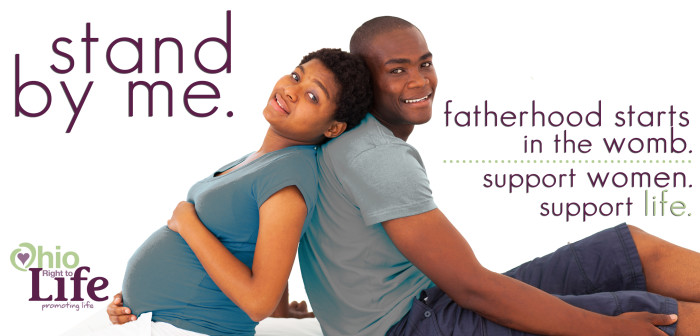
Although it’s an important issue, the ads don’t just focus on the high abortion rate among black women. My favorite ad is this one, which reminds men that fatherhood begins with two pink lines.
pregnant african woman and husband sitting on bed
The billboard is positive, but emphatic in its message: a real man doesn’t just fork over $300 and encourage the woman carrying his baby to “take care of it.” Real men stand by and support pregnant women and children–including children in the womb.
As of 2012, 42 percent of abortions in Ohio were performed on black women–an extremely high number far out of proportion with their share of the general population. A young black woman, Lakisha Wilson, was killed earlier this year at a clinic in Cleveland, which Ohio Right To Life calls the “abortion capital” of Ohio.
“We want to see abortion end for every race,” said McCann. “By increasing awareness and encouraging a familial support system, we hope to engender a culture of life for mother, father, and child alike.

Source: LiveAction News

Abortion/Adoption


Daughter of Mentally Challenged Reno Woman who was almost forced to abort adopted by Grandparents


By Melissa Clement, President, Nevada Right to Life
Cierra Marie
Cierra Marie

Nearly two years after the Washoe County Family Court case that shocked the nation, Cierra Marie, a little girl, whose life was threatened by a potential court ordered abortion, has a forever home.
This past Friday the long process ended with a happy ending. Bill and Amy Bauer adopted their beautiful granddaughter in the same court where once her life was threatened.

In the Fall of 2012, Bill and Amy were summoned to a Washoe County Court, forced to justify their faith and their respect for life. They were challenged to explain what they were going to do about their mentally challenged daughter’s pregnancy at the hands of an unknown sexual predator.
Asked why they intended to support their daughter’s pregnancy, they said that their faith told them that all human life was valuable and that they intended to help her despite her circumstances as long as the child was not a threat to their daughter’s life. The judge set into motion a series of hearings that seemingly could only end in the loss of an innocent human life at the hands of the state.

The Bauers’ attorney, Alliance Defending Freedom attorney Jason Guinasso, says the court then “responded to them by stating their faith had no relevance to the decision that had to be made regarding carrying the pregnancy to term or not. Further, the Court set up a series of hearings over the course of 40 days to consider whether to force Bill and Amy’s daughter to have an abortion. Indeed, the doctor summoned by the Court stated at one of the hearings that the only compassionate thing to do was to sterilize the Bauers’ daughter and abort the baby.”

However, thanks to the work of countless people across the country and led by Guinasso, the court and the county, against all odds, changed direction and agreed to support this woman and her unborn baby.

This case was a victory for American families. If the court had ordered an abortion, it would have sent a clear and unmistakable message that courts can intervene in family matters to order an abortion against the family’s wishes.
This case also revealed a clear and present danger to families that that courts could trample on their religious beliefs.

Not only pro-life supporters felt threatened. Many who consider themselves pro-choice recognized the threat to family autonomy, “choice” and religious liberty.
This truly was a bridge too far and fortunately the Court recognized it as such. As bioethicist, Wesley Smith noted
“If a court orders an abortion opposed by the parents/guardians of this woman, and the woman herself (who is not capable of informed consent)-absent clear and convincing evidence that the pregnancy poses a substantial risk to the woman’s life… we will have entered territory once inhabited exclusively by China.”

Source: NRLC News

Tuesday, August 5, 2014

Post- Abortion


The devastating reality of Post Abortion Stress Syndrome


By Christina Martin
woman-thought2She sat across from me, tears streaming down her face. The subject of abortion came up and this woman struggled to discuss it. ‘Emotionally damaging’ was the phrase she used to describe the procedure.
She thought about her child. She wondered how old he or she may be. As she reflected on her past she wrestled with feelings of regret. She admitted to choosing abortion without knowing all of the facts. She felt rushed into the decision, wishing now that she would have gathered more information before she decided.

This woman’s story is all too common. In the decade I’ve been involved in the pro-life movement I’ve heard similar tales. I met a woman who was so affected by her abortion that she couldn’t talk about it for 20 years.

Another lady shared a chilling story of using the RU-486 pill and the absolute horror she faced witnessing her unborn baby pass. I remember the African-American woman who pulled me aside and whispered her confession. The pain of her choice etched upon her face.
Susanne Babbel is a licensed Marriage and Family Therapist who has a P.H.D in Psychology. She is also a psychotherapist with an emphasis on trauma and depression. In an article for ‘Psychology Today’ titled, ‘Post Abortion Stress Syndrome (PASS) – Does It Exist?’ she writes: ‘No matter your philosophical, religious, or political views on abortion, the fact of the matter is, the actual experience can affect women not only on a personal level but can potentially have psychological repercussions.’
Babbel refers to this as Post Abortion Stress Syndrome. (PASS) is based on Post Traumatic Stress Disorder (PSTD). It’s the name given to the psychological aftereffects of abortion. Babbel notes that the disorder is real, although the term has not been recognized by the American Psychological Association.

Sadly those who support abortion often refuse to acknowledge that long term negative effects that it can bring to many women. The National Abortion Federation calls (PASS) a ‘myth‘ and the popular liberal Ms. Magazine says it’s a ‘bogus affliction invented by the religious right’.
However Babbel asserts “any event that causes trauma can indeed result in PTSD, and abortion is no exception.” Babbel is not declaring this because she’s a pro-life therapist. She further states, ‘Believing that PASS exists does not mean that one does not believe in a woman’s right to choose; it simply means that one believes in supportive and constructive counseling around the trauma symptoms’. Babbel lists ‘guilt, anxiety, numbness, depression, flashbacks, and suicidal thoughts as symptoms of PASS.

Babbel makes no claim that these symptoms will follow after every abortion. She writes: While abortion can induce post-traumatic stress in some, others will suffer no repercussions at all. I can understand that statement.

I personally believe there is an undeniable, emotional, physical, and even spiritual connection between a mother and a child. However, I’ve met a number of post-abortive women who have a range of experiences. I don’t oppose abortion solely because I believe it will cause trauma to a woman’s soul. I oppose abortion because it’s morally wrong to destroy the life of a fetus. Some women will make that destructive decision with little sorrow, regret, or negative emotional consequences.
We live in a society that views abortion as a private decision which women need not regret. Therefore women with seemingly ‘positive’ abortion experiences are often encouraged to share them with pride. However women with negative experiences find themselves in a difficult place. They suffer from the pain of their abortion, all the while living in a society that tells them that pain isn’t real or necessary.

Thankfully organizations are here for that very reason. They are safe places for women who need healing after their abortion. If you or anyone you know has suffered emotional or physical pain from an abortion, there is help available to you. You are not alone. You don’t have to carry the secret or live in shame. Check out resources like Afterabortion.org and take a step towards freedom.

Editor’s note. This appeared at liveactionnews.org.

Source: NRLC News

Crisis Pregancy


Helping women in crisis pregnancy situations see we care enables reason to replace panic


By Dave Andrusko
ListeningWhy do some people readily hear our message of love and compassion for mother and unborn child while to others it is not so much rejected as it comes across as unimportant or “background noise”? Here’s a thought, based on a piece written by Seth S. Horowitz, published in the New York Times, that was passed along to me.

In “The Science and Art of Listening,” Horowitz, an auditory neuroscientist at Brown University, employs a three-tiered explanatory system to explain the complexity of hearing and to distinguish hearing from listening and the role of attention. He observes that because there is no place that is totally silent
“your auditory system has evolved a complex and automatic ‘volume control,’ fine-tuned by development and experience, to keep most sounds off your cognitive radar unless they might be of use as a signal that something dangerous or wonderful is somewhere within the kilometer or so that your ears can detect.”
Which is where attention kicks in, by no means a “monolithic brain process.” These different types of attention employ different parts of the brain. The simplest is the startle– “observed in every studied vertebrate,” he writes. The most complex –where you “actually pay attention to something you’re listening to”–involves more sophisticated parts of the brain.
So what allows you to “actively focus on what you’re hearing and tune out sights and sounds that aren’t as immediately important”? According to Horowitz, “In this case, your brain works like a set of noise-suppressing headphones, with the bottom-up pathways acting as a switch to interrupt if something more urgent …. grabs your attention.”
Needless to say in a world filled with sensory overload and virtually limitless access to information, while hearing is easy, it’s because increasing difficult to hone the skill of listening.
But Horowitz says that like any other skill, we can train our listening. Think of how his conclusion applies to our pro-life work:
“’You never listen’ is not just the complaint of a problematic relationship, it has also become an epidemic in a world that is exchanging convenience for content, speed for meaning. The richness of life doesn’t lie in the loudness and the beat, but in the timbres and the variations that you can discern if you simply pay attention.”
It is difficult to get people to focus on, to pay attention to, the abortion issue, and for many reasons. However, it’s not because abortion is trivial; in fact it resonates with an impulse we’ve tried to mute– to protect our own.

Rather, it is hard to get people to pay attention because abortion is off their “cognitive radar.” Why? Both because they do not see the danger that abortion poses to unborn children AND their mothers, and because they do not see how wonderful it is, how ennobling it is, to stand up against those who tell women that abortion is the “easy” way out.

And to be clear, it is very, very easy to see why women in a crisis pregnancy situation do not “pay attention.” This is not welcomed news, it startles them (to borrow from Horowitz’s first stage of hearing), and the first instinct is to flee—to get “out” of the situation by aborting the baby.
One of our tasks—our principle task short-term—is to slow down the rush to (fatal) judgment, to help the mother see she is not alone, that we care. In explaining how we can train the skill of listening, Horowitz offers a relevant insight. He is talking about our “significant others,” but it applies perfectly here:
“Listen to your significant other’s voice — not only to the words, which after a few years may repeat, but to the sounds under them, the emotions carried in the harmonics.”
We need to be able to listen to what is underneath the pregnant teen’s (or grown woman’s) statement that she wants an abortion.
In many, many cases, it is actually a declaration with a question as subtext. She is asking, “Does it matter to you? Do I matter to you?”

When she sees that this DOES matter to us, that we ARE listening, often times the panic subsides and reason replaces fright.
And what a glorious day that is—for her, her unborn baby, and for you.

Source: NRLC News

Life


Haleigh’s new life after State wanted her dead


By Wesley J. Smith
 Haleigh played on the front lawn with her adoptive father, Keith Arnett, and brother, Jacob. The Arnetts first took Haleigh in as a foster child.  Suzanne Kreiter/Globe staff
Haleigh played on the front lawn with her adoptive father, Keith Arnett, and brother, Jacob. The Arnetts first took Haleigh in as a foster child.
Suzanne Kreiter/Globe staff

It’s been awhile since I have written of Haleigh Poutre. Some may recall that she was an abused child beaten into a sustained unconsciousness by her step father.
Adding near-killing to her injury, within days of being diagnosed, doctors decided she would never get better and the state sought court permission to make sure she died “with dignity” by having her respirator and feeding tube removed.

Happily, just before the deed was to be done, she awakened. From my 2006 NRO article, “Danger Zone:”

Within a week or so of the beating, her doctors had written her off. They apparently told Haleigh’s court-appointed guardian, Harry Spence, that she was “virtually brain dead.” Even though he had never visited her, Spence quickly went to court seeking permission to remove her respirator and feeding tube.
The court agreed, a decision affirmed recently by the supreme court of Massachusetts. And so, no doubt with the best of intentions, a little girl who had already suffered so much was stripped by the Commonwealth of Massachusetts of even the chance to fight to stay alive. If she didn’t stop breathing when the respirator was removed, which doctors expected, she would slowly dehydrate to death.
Then came the unexpected: Before “pulling the plug” on Haleigh, Spence finally decided to visit her. He was stunned. Rather than finding a little girl with “not a chance” of recovery, as doctors had described Haleigh’s condition to him (as reported by the Boston Globe), Haleigh was conscious. She was able to give Spence a yellow block when asked to by a social worker and respond to other simple requests
Not only did Haleigh awaken, but she learned to eat on her own and began rehab and school.
Now, she has a real, loving family. From the Boston Globe story:
The minister winds up his welcome to some 400 people, and soon lyrics flash karaoke-like on a large screen. A spirited Christian pop song, “Blessed be Your Name,” fills the Westfield Evangelical Free Church. In the back row, a young woman, sitting in a wheelchair next to her adoptive parents, lights up.
Though she can’t read all the words, she sways to the music and claps her hands, the nails painted pink with white polka dots. She loves cheerful tunes and a crowd, and on this Sunday, she has both. Keith and Becky Arnett could have predicted that Haleigh, 20, would brighten at this part of the service. She entered their lives as a 14-year-old foster child, then known as Haleigh Poutre, who had been at the center of a passionate end-of-life court battle. Her singular story of abuse, compounded by government lapses, drew national media attention. It remains one of the darkest chapters in the state’s child-protection system.

The case caused MA to reform its laws. But have the bioethical values that led to this almost killing changed? From what I observe, no. Indeed, they have gotten even worse.
Think about this. Think about it hard: The “quality of life ethic” pushed vociferously in mainstream bioethics–and almost implemented by state bureaucrats–came very close to killing Haleigh by dehydration. It would have happened had it not taken the procedure months to get MA Supreme Court permission.

And now think about this: If euthanasia had been legal, she could have been lethally injected with not enough time to recover. And don’t think that will never happen if society swallows the hemlock. Child euthanasia and medicalized killing of children already happens in the Netherlands and Belgium.

It is a very dangerous thing to create a invidious categories of people denigrated by medical technocrats as having lives not worth living–or paying for.
So, the next time a bioethicist argues that we must dehydrate a child or other cognitively disabled person to death in “their best interests,” remember Haleigh Poutre. Sometimes doctors are wrong. Sometimes “miracles” do, indeed, happen. If we are to err, it should be on giving life a chance.

Source: NRLC News

Abortion


Pro-death=pro-family for abortion advocates


By Dave Andrusko
Abortionadvocates3There is an ironclad axiom that you can count on as surely as the sun rising in the east. Responding to a criticism of their movement, once a pro-abortion activist says “nothing could be further from the truth,” their evasive rebuttal inevitably invites the response that “nothing could be further from the truth.”

Sarah Erdreich penned a post titled, “Why the Pro-Choice Movement Needs to Talk About Children” at the pro-abortion site rhrealitycheck.org. I am taking a few minutes of your time to survey this nonsense both for what it says about how and why they must pigeonhole us in order to try to wiggle out of their own predicament.

None of this “Every Child a Wanted Child” for Erdreich. Her favorite is “Pro-Child, Pro-Family, Pro-Choice.”

[By way of clarification “pro-child” means pro-child-when-I-want-you; “pro-family” is to suggest that the rest of the family will be strengthened if you eliminate those pesky kids who come along at inconvenient times; etc., etc.]

Erdreich tells her readers she can understand why “the mainstream pro-choice movement seems to have moved away from this focus on the family in favor of concentrating on the arenas of courtrooms and state houses.” After all those crazy pro-lifers are passing legislation left and right…
But when, I ask you, was “pro-family” either an integral part of the abortion movement’s rhetorical arsenal or a real reflection of its priorities? Never. Consider: you have to be some place before you can be said to have “moved away from this focus on the family.”
However the thrust of her piece is that the emphasis on other fronts has left the pro-choice movement “open to charges that it is anti-child and anti-family.”
Which brings us to her “Nothing could be further from the truth” remark. Her evidence?
Planned Parenthood! In its very name is
“embedded the very idea of healthy families and children: the idea that people can and should plan their families. Being deliberate and thoughtful about when to have children ensures that every parent is as prepared as possible for the responsibility of raising a child.”
So what if PPFA takes the lives of over 330,000 unborn babies annually? To the parental failure to be “deliberate and thoughtful,” PPFA stands—curette and forceps in hand—to guarantee a “solution,” as bloody as it is unmerciful.

Besides, “The majority of women who have abortions are mothers,” Erdreich writes. True. At the same time we have reduced the number of teenagers having abortions, there has been an increase in the number of women who have already given birth who abort subsequent pregnancies.
The central truth lost here is that they were also mothers when they were carrying that baby whom they would later abort—the mother of that particular girl or boy. As many women who have had abortion later came to realize, they are now mothers of a dead baby.

Second, (good abortion advocate that she is) Erdreich makes killing your children merely one option on a decision tree that includes “contraception, access to good prenatal care, and the right of any woman to have a child.”
Preventing the creation of a new life=ending that new life=taking care of the new life that you allow to be born are all equally valid choices, just part of the “continuum.”
But what to do to remedy this weakness of the “pro-choice movement”? She has a variety of ideas but they are all in service of keeping “conversion” conversations going.
“Emphasizing the pro-family roots and goals of abortion activism is an excellent way to keep these conversations open. If the conversation isn’t so much about abortion per se, but rather abortion’s role in protecting the rights of each family, it can avoid the feeling of discussing a ‘third rail’ and perhaps illustrate that ever-elusive common ground.”
So, as always, the end point is to turn the conversation away from abortion and to conjure up an imaginary moral equivalence. How? Blur everything together under the heading of “protecting the rights of each family.”

If you choose to abort a child, or more than one child, and I protect each of mine, it’s six of one, half dozen of the other.
And second only to the deaths of these children is the sobering thought that people like Erdreich actually believe the tale of sophistry and evasion they have so cunning woven.

Source: NRLC News

Baby


Tiny baby undergoes rare heart surgery, prognosis great for “Mighty Girl”


Mom hopes she will ‘grow into whatever God has for her’

By Dave Andrusko
Alexandra Mae Van Kirk
Talk about beating the odds! First, the parents of Alexandra Mae Van Kirk, also known as “Mighty Girl,” find that at 22 weeks their unborn baby girl is not developing as she should. As the months roll by, the prognosis grows worse and worse.
“They gave her 35 percent chance of making it to a live birth,” her mother Heidi Van Kirk told Michigan Live news. A little over a month ago—at Alexandra’s 32-week check up—doctors quickly counsel an emergency Cesarean Section:
Alexandra’s growth was below 1 percentile!
But Alexandra (nicknamed Sasha) made it, weighing in at 2 pounds, 3 ounces. And she came out yelling.
“She had us all very, very happy when she came out screaming,” Heidi told reporter Sue Thoms.
But Sasha was diagnosed with a narrowed artery– pulmonary stenosis. Obviously doctors would have preferred to wait before performing heart surgery on a tiny, tiny baby, but they had no choice.
Sasha also had Hirschsprung’s disease, “a condition that causes missing nerve cells in part of the colon,” according to Thoms. That problem was addressed for now on July 18 (Alexandra will have further surgery when she is older), but her blood oxygen levels did not go up.
Fortunately, Dr. Joseph Vettukattil, an internationally known children’s heart specialist, had been recruited from England a year ago to serve as chief of pediatric cardiology at DeVos Children’s Hospital in Grand Rapids, Michigan. He has performed over 300 pulmonary balloon valvuloplasty procedures in the last two decades.
But that didn’t mean the July 23 surgery wasn’t “tricky.” Dr. Vettukattil’s tiniest patient on whom he had performed the surgery on was four pounds.
As Thoms explained of Alexandra’s walnut-sized heart:
“In that tiny heart are four chambers. And in one of those chambers lay a thickened valve that pinched an artery, forcing the heart to work extra hard to pump blood to the lungs.
“Vettukattil’s mission was to thread a catheter with an inflatable balloon into the slender artery and expand the balloon, widening the opening so blood could flow through easily.”
But the operation was a complete success! And if she like most babies who undergo at a valvuloplasty procedure, she shouldn’t need any further treatment.
“She’s cured. As far as her heart goes, she should be fine for the rest of her life,” Dr. Vettukattil told Thoms.
“There is a sense of relief that is almost unexplainable,” Heidi said. “She’s doing fantastic,” her father, Matt Van Kirk told the Grand Rapids Press.
Here’s how Thom’s ends her wonderful story:
“Her parents are looking forward to the day Alexandra can come home from the hospital. They picture her playing with her big sister, 17-month-old Josephine. And they hope she will ‘grow into whatever God has for her,’ Heidi said.”

Source: NRLC News

Monday, August 4, 2014

50 Shades of What?

This summary is not available. Please click here to view the post.

Chasity

Hollywood Now Considers Anyone Who Practices Abstinence a Freak

by Brent Bozell 

Back in the 1950s, C.S. Lewis saw chastity as under attack with “all the contemporary propaganda for lust that makes people “feel that the desires we are resisting are so ‘natural,’ so ‘healthy,’ and so reasonable, that it is almost perverse and abnormal to resist them.”
You can now safely delete the word “almost.”
Today virginity isn’t a virtue but a burden. Chastity is a freak show and anyone who chooses to keep it is a carnival barker. In today’s entertainment world, weirdos — especially sexual weirdos — drive a juicy plot, so virgins are in vogue, as a target or merely as an anthropological curiosity.
teencouple8MTV has a new reality show called “Virgin Territory” where four young participants explain their “very tumultuous journey” in the “tricky world of virginity.” MTV sells it as pathos: “Whether they’re trying to lose their V-cards or keep them safely tucked in their pockets for as long as possible, being pure is really starting to grate on them.”
MTV’s Executive Vice President of Series Development Lauren Dolgen tried to make this sound like a public service. Because of a partnership with The National Campaign to Prevent Teen and Unplanned Pregnancy, she claimed, “MTV will continue this tradition by elevating the discussion of responsible sexual health to include the topic of virginity in a way that our audience might find surprising.”
Translation: MTV’s challenge is to find “a way” to introduce the virtue of virginity without projecting its virtue.
As TV critic Willa Paskin at Slate.com explained, the show “tries to get into psychological explanations for all of this unwanted virginity, because like the participants’ friends, MTV thinks it’s weird.” Variety TV critic Brian Lowry nailed it on the head. “Some networks will pimp kids out — under cover of sex education — to score ratings.”

Then there’s the new film “Very Good Girls” in which two college-bound Brooklyn, New York, girls resolve to lose their virginity over the summer, but both target the same boy who vends ice cream at the beach. It’s not a teen sex comedy; it’s meant to be more profound. “When we lose our innocence, we have to find ourselves,” announced the trailer.

Susan Wloszczyna at RogerEbert.com wasn’t impressed. “(They) decide to relieve themselves of the burden that is their virginity,” she wrote. To celebrate their decision, they strip down and run stark naked on a crowded public beach before leaping into the water.” She called the film “a very bad excuse” to see the former child actress Dakota Fanning “flash her bare fanny, fondle herself provocatively and cavort in her underwear for no dramatic purpose.” Director Naomi Foner Gyllenhaal described these two characters revolting against their virginity as “serious, interesting, committed girls about how they become women.” She said this movie is rare, because women “don’t often see themselves with any reality on screen.”

There it is again. “Reality” is defined by Hollywood’s sexual-liberation ethos. Women who decide to retain their virginity are somehow not “real” women and certainly can’t expect to see their “reality on screen.” The “contemporary propaganda for lust” just never stops coming.

LifeNews Note: L. Brent Bozell III is the president of the Media Research Center and the publisher of Newsbusters. 

Source: LifeSite News

Saturday, August 2, 2014

Ireland-- Cherish Life


Pope’s Message to People of Ireland – Cherish Life


By LifeZine
Editor’s note. LifeZine is a publication of the Irish Family & Life Organization, a leading Irish pro-life organization.
Pope Francis and a young fan
In a special message to Catholics in Ireland and Britain for the annual ‘Day for Life’, Pope Francis has called on young Catholics in particular to work “to ensure adequate legal protection for the fundamental human right to life”.
The theme of this year’s Day for Life, which will be celebrated in Ireland on Sunday October 5, is #livelife Protect and Cherish Life from its beginning to its natural end.
Pope Francis expressed his confidence “that this annual witness to the sanctity of God’s gift of life will inspire the faithful, and young Catholics in particular, to combat the culture of death, not only by working to ensure adequate legal protection for the fundamental human right to life, but also by seeking to bring the merciful love of Christ as a life-giving balm to those troubling ‘new forms of poverty and vulnerability’ (cf. Evangelii Gaudium 210) which are increasingly evident in contemporary society.”